
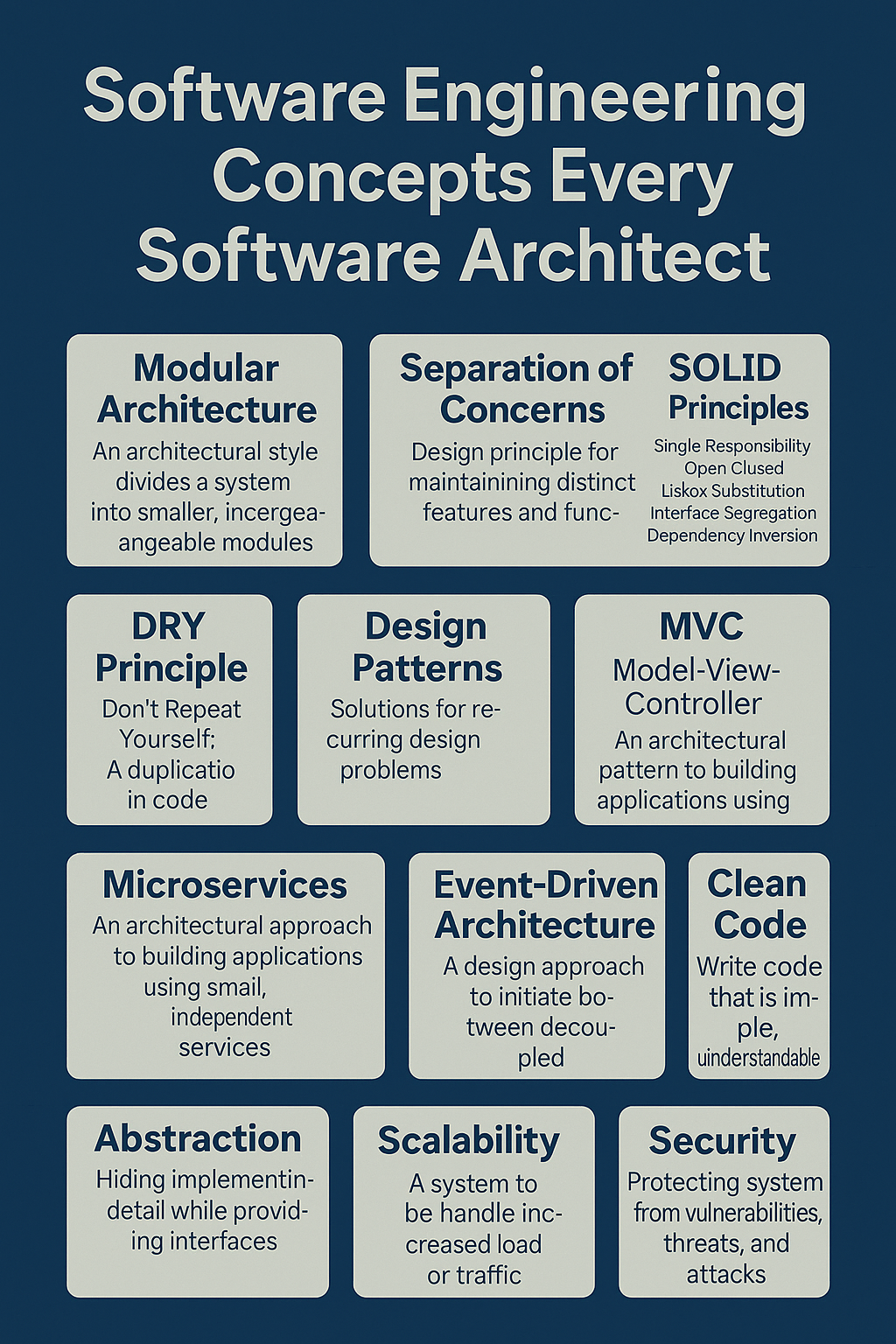
Software Engineering Concepts for Software Architects
Software engineering concepts for software architects revolve around designing scalable, maintainable, and high-performing systems. Key principles include modular architecture, separation of concerns, SOLID and DRY principles, and design patterns like MVC, microservices, and event-driven architecture. Architects must ensure clean code, proper abstraction, and technology alignment with business goals. Emphasis is placed on system reliability, security, scalability, and performance. Knowledge of CI/CD pipelines, DevOps practices, cloud architecture (AWS/Azure/GCP), and containerization (Docker, Kubernetes) is vital. Architects also need strong documentation, communication, and decision-making skills to guide teams, manage stakeholders, and balance trade-offs in technical and business requirements.
🔹 1. Core Responsibilities of a Software Architect
| Responsibility | Description |
|---|---|
| Architecture Design | Define high-level structure, modules, interfaces, dependencies |
| Technology Selection | Choose tech stack based on scalability, performance, maintainability |
| Scalability Planning | Ensure architecture supports horizontal and vertical scaling |
| Code & Design Reviews | Maintain high quality and standard practices |
| Mentorship | Guide developers on patterns, practices, design |
| Stakeholder Communication | Translate tech decisions for product/business teams |
🔹 2. Architecture Patterns
| Pattern | Use Case |
|---|---|
| Monolithic | Small teams, simple deployments |
| Layered (N-Tier) | Standard enterprise apps (UI, business, data) |
| Microservices | Decoupled, scalable services (Netflix, Amazon) |
| Event-Driven | Async systems, real-time (Kafka, RabbitMQ) |
| Serverless | Low maintenance, sporadic workloads |
| Service-Oriented | Reusable, loosely coupled services |
| Hexagonal (Ports & Adapters) | Testable and adaptable systems |
🔹 3. Design Principles
| Principle | Meaning |
|---|---|
| SOLID | 5 OOP principles for maintainable code |
| DRY | Don’t Repeat Yourself |
| KISS | Keep It Simple, Stupid |
| YAGNI | You Aren’t Gonna Need It |
| Separation of Concerns | Split code into distinct sections of responsibility |
| High Cohesion, Low Coupling | Modules should do one thing and be independent |
🔹 4. Key Architectural Concerns
| Concern | Examples |
|---|---|
| Scalability | Load balancers, distributed databases |
| Availability | Redundancy, failover |
| Performance | Caching, DB indexing, CDN |
| Security | OAuth2, HTTPS, Encryption, RBAC |
| Maintainability | CI/CD, documentation, modular code |
| Extensibility | Plugin architecture, event buses |
🔹 5. Common Design Patterns (Gang of Four)
| Pattern Type | Examples |
|---|---|
| Creational | Singleton, Factory, Builder |
| Structural | Adapter, Facade, Proxy |
| Behavioral | Observer, Strategy, Command |
🔹 6. System Design Concepts
A Software Architect must be able to:
- Design scalable distributed systems
- Use Load Balancers, CDNs, Caching layers
- Choose between SQL vs NoSQL
- Apply Sharding, Partitioning, Replication
- Design Database schemas and data flows
- Implement APIs (RESTful, GraphQL, gRPC)
- Define CI/CD pipelines
🔹 7. Non-Functional Requirements (NFRs)
| NFR | Considerations |
|---|---|
| Performance | Latency, throughput |
| Scalability | Load handling capability |
| Security | Authentication, authorization, audit |
| Availability | Uptime % (SLA) |
| Maintainability | Ease of fixes/updates |
| Observability | Logging, metrics, tracing |
🔹 8. Microservices-Specific Concerns
- Service discovery (e.g., Eureka, Consul)
- API Gateway (e.g., Kong, NGINX, Spring Cloud Gateway)
- Circuit Breakers (e.g., Resilience4j, Hystrix)
- Eventual consistency (Kafka, RabbitMQ)
- Centralized logging (ELK stack, Grafana, Prometheus)
- Containerization (Docker, Kubernetes)
🔹 9. Security Concepts
| Concept | Implementation |
|---|---|
| Authentication | OAuth2, JWT, LDAP |
| Authorization | RBAC, ABAC, Claims-based |
| Data Protection | Encryption (AES, TLS), Hashing (bcrypt) |
| API Security | API keys, rate limiting, IP whitelisting |
| Secure SDLC | Threat modeling, static analysis |
🔹 10. Software Development Methodologies
| Methodology | Description |
|---|---|
| Agile | Iterative, user-feedback based |
| Scrum | Sprints, stand-ups, backlogs |
| Kanban | Continuous flow, WIP limits |
| DevOps | Culture of automation, CI/CD, monitoring |
| CI/CD | Continuous integration, deployment, rollback |
🔹 11. Tools Every Architect Should Know
| Category | Tools |
|---|---|
| Design & Modeling | Lucidchart, Draw.io, ArchiMate |
| Source Control | Git, GitHub, GitLab |
| Build & CI/CD | Jenkins, GitHub Actions, GitLab CI |
| Containers | Docker, Kubernetes |
| Cloud | AWS, Azure, GCP |
| Monitoring | Grafana, Prometheus, ELK, Datadog |
| Testing | JUnit, Postman, Selenium, SonarQube |
🔹 12. Important Interview Topics for Architects
| Category | Must-Know Topics |
|---|---|
| System Design | URL Shortener, Rate Limiter, Notification System |
| Concurrency | Locks, Semaphores, Multithreading |
| Data Structures | Trees, Graphs, Hash Tables |
| Databases | Indexing, ACID, CAP, Normalization |
| Network Basics | HTTP/HTTPS, TCP/IP, WebSockets |
| Security | CSRF, XSS, JWT, OAuth2 |
| Cloud Concepts | SaaS vs PaaS vs IaaS, Auto-scaling, Storage options |
✅ Architecture Scenario-Based Questions
🧠 Q1: How would you design a high-traffic e-commerce system?
Points to cover:
- Load Balancer (HAProxy, ALB)
- Web + API Layer (containerized)
- Microservices for payments, products, orders
- Redis for caching
- CDN for static assets
- Queue for order processing
- Sharded SQL or NoSQL for products/orders
- Monitoring & logs
🧠 Q2: How would you design a logging & monitoring architecture?
- Fluentd/Filebeat → Logstash → Elasticsearch → Kibana
- Prometheus + Grafana for metrics
- Alerts via PagerDuty or Slack
- Tracing: OpenTelemetry, Jaeger, Zipkin
🧠 Q3: How to decide monolith vs microservices?
| Factor | Monolith | Microservices |
|---|---|---|
| Team size | Small | Large |
| Deployment | One unit | Independent services |
| Scalability | Less flexible | Highly scalable |
| Complexity | Simpler | More complex (network, ops) |
| Speed to market | Faster initially | Slower setup, scalable long-term |
✅ Real-World Architecture Breakdown, UML, Q&A, Templates
📘 A. Real-World Architecture Case Study: E-Commerce Platform
🔹 Problem Statement:
Design a scalable E-Commerce Application that supports:
- Product browsing & search
- User login/cart/orders
- Payment gateway integration
- Scalability under high load
🔹 High-Level Architecture Components:
[User Device]
     ↓
[Load Balancer]
     ↓
[API Gateway]
     ↓
 ┌────────────┬─────────────┬─────────────┐
 │ ProductSvc │ CartService │ OrderService│
 └────┬───────┴───────┬─────┴──────┬──────┘
      ↓               ↓            ↓
 [Product DB]    [Redis + Cart DB] [Order DB]
      ↓               ↓            ↓
    [CDN]        [Session Cache]  [Payment Service → Gateway]
🔹 Tech Choices:
| Concern | Tool/Tech |
|---|---|
| API Gateway | NGINX / Spring Cloud Gateway |
| Auth | JWT + OAuth2 |
| Cache | Redis |
| DB | PostgreSQL (normalized), MongoDB (products) |
| Queue | Kafka/RabbitMQ (order events) |
| Payment | Stripe/PayPal Integration |
| CDN | Cloudflare / AWS CloudFront |
🧩 B. UML/ER Diagram Descriptions
🔹 1. UML Class Diagram (for User + Cart + Product)
User
├─ userId : UUID
├─ name : String
└─ email : String

Product
├─ productId : UUID
├─ title : String
├─ price : Double
└─ stock : Integer

CartItem
├─ cartItemId : UUID
├─ productId : FK
├─ quantity : Integer
└─ userId : FK
🔹 2. Sequence Diagram (Place Order)
EditUser → API Gateway → OrderService → InventoryService
                            ↓
                        PaymentService → Gateway
                            ↓
                        Success → DB Save
                            ↓
                      Send Email/Invoice
🔹 3. ER Diagram Overview
[User]──<owns>──[Cart]──<has>──[CartItem]──<refers>──[Product]
                       │
                    [Order]──<has>──[OrderItem]──[Product]
❓ C. Architect-Level System Design Questions
Q1: How do you scale a read-heavy system?
Answer:
- Add read replicas
- Implement caching layers (Redis/Memcached)
- Use CDNs for static content
- Use denormalized views/materialized views for fast access
Q2: How would you design a rate-limiter system?
Answer:
- Use Redis token bucket/leaky bucket
- Store request counts in Redis with TTL
- Use API keys and rate-limiting middleware at API Gateway
Q3: How do you manage configuration across microservices?
Answer:
- Use centralized config service (e.g., Spring Cloud Config, Consul)
- Store configs in Git + reload on change
- Use secrets manager for sensitive config (Vault, AWS Secrets Manager)
Q4: How do you ensure eventual consistency in microservices?
Answer:
- Use event sourcing and message queues
- Services publish domain events (Kafka)
- Consumers handle updates asynchronously
- Implement idempotent operations to avoid duplication
Q5: Design a file upload and sharing service (like Google Drive)
- Chunk file upload via presigned URLs
- Store in object storage (S3, MinIO)
- Metadata in RDBMS
- Access via temporary signed links
- Virus scanning pipeline (async)
📄 D. Architecture Documentation Template (Real Use)
📘 1. System Overview
A brief summary of what the system does.
📘 2. Stakeholders
Devs, Ops, Product, QA, etc.
📘 3. High-Level Architecture Diagram
Include network layers, gateways, services, storage.
📘 4. Component Details
| Component | Description |
|---|---|
| Auth Service | Issues JWT tokens using OAuth2 |
| Product API | CRUD for product catalog |
| Order Svc | Handles order state + payments |
📘 5. Data Flow
Diagrams for read/write flows, payment process, etc.
📘 6. NFRs
- Performance: 1000 RPS
- Uptime: 99.99%
- SLA: 500ms latency max
📘 7. Scalability Plan
- Kubernetes HPA
- Caching tier
- DB replica scaling
📘 8. Security
- HTTPS only
- OAuth2, TLS v1.2
- RBAC + Logging
✅ Fundamental Concepts of Software Engineering (Architect-Level)
🔹 1. Software Development Life Cycle (SDLC)
📌 Phases:
- Requirements Analysis
- Design
- Implementation
- Testing
- Deployment
- Maintenance
💡 Architect’s Role:
- Translate business needs into technical designs
- Define boundaries and constraints
- Choose the right methodology (Agile, Waterfall, Spiral, etc.)
🔹 2. Software Architecture vs. Software Design
| Concept | Architecture | Design |
|---|---|---|
| Focus | Structure & interactions of components | Implementation of modules & classes |
| Abstraction Level | High-level | Medium to low-level |
| Responsibility | Technology stack, NFRs, integration | Class structures, algorithms |
🔹 3. Modularity
Divide system into independent, cohesive modules.
📌 Benefits:
- Easier to test, reuse, and maintain
- Reduces ripple effects when changes are made
🔹 4. Abstraction
Hide internal details and expose only what is necessary.
Examples:
- API exposing only method signatures
- Database ORM hiding SQL complexity
🔹 5. Encapsulation
Wrap data and operations in a single unit (e.g., a class).
Ensures:
- Security
- Controlled access
- Better design integrity
🔹 6. Cohesion & Coupling
| Concept | Goal |
|---|---|
| Cohesion | High: modules do one thing well |
| Coupling | Low: modules are loosely connected |
🔧 Architect’s Goal: Maximize cohesion, minimize coupling
🔹 7. Separation of Concerns (SoC)
Each part of the application should deal with a specific responsibility.
Example:
- UI → View Layer
- Logic → Service Layer
- Persistence → Repository Layer
🔹 8. Non-Functional Requirements (NFRs)
Architects must design for NFRs:
| NFR | Meaning |
|---|---|
| Scalability | System handles growth (users, data, traffic) |
| Availability | High uptime, fault tolerance |
| Security | Access control, encryption, secure transport |
| Performance | Fast response time, low latency |
| Maintainability | Ease of updates and fixes |
🔹 9. Design Patterns
Reusable solutions to common design problems.
| Category | Examples |
|---|---|
| Creational | Singleton, Factory, Builder |
| Structural | Adapter, Facade, Decorator |
| Behavioral | Observer, Strategy, Command |
🔹 10. Architecture Styles
| Style | Use Case Example |
|---|---|
| Monolithic | Simple apps, single unit |
| Layered (N-tier) | Enterprise apps, separation of concerns |
| Microservices | Scalable apps with independent modules |
| Event-driven | Systems with async processing (Kafka, RabbitMQ) |
| Service-Oriented (SOA) | Reusable business services |
| Serverless | Lightweight APIs, sporadic workloads |
🔹 11. Version Control & CI/CD
- Git for versioning
- CI: Automated builds, tests (Jenkins, GitHub Actions)
- CD: Automated deployment to staging/prod
Architects define pipeline flow, branching strategy (e.g., trunk-based vs. GitFlow)
🔹 12. Testing Types
| Type | Purpose |
|---|---|
| Unit Testing | Test smallest unit (functions) |
| Integration Test | Test modules working together |
| System Test | Full end-to-end test |
| Performance Test | Measure latency, throughput |
| UAT | Validate with end-users |
🔹 13. Code Quality and Standards
- Code review practices
- Static analysis tools (e.g., SonarQube)
- Clean Code principles (readable, DRY, modular)
🔹 14. Agile & DevOps Fundamentals
| Agile | DevOps |
|---|---|
| Iterative, fast delivery | Automate delivery, operations |
| Scrum, Kanban | CI/CD, Monitoring, Infrastructure as Code |
| User stories, sprints | Containerization, Cloud-native |
🔹 15. Documentation Must-Haves
| Document | Purpose |
|---|---|
| High-Level Design (HLD) | Diagrams + architecture overview |
| Low-Level Design (LLD) | Class details, API contracts |
| API Spec (Swagger/Postman) | Communicate endpoints, responses |
| Deployment Guide | How to build, run, and scale the app |
🧠 Summary Cheat Sheet
| Concept | Key Idea |
|---|---|
| SDLC | Life cycle of software development |
| Architecture vs Design | Structure vs Implementation details |
| Modularity & SoC | One module = one concern |
| Patterns | Reusable design solutions |
| NFRs | Plan for performance, security, etc. |
| CI/CD | Automate delivery + testing |
| Agile + DevOps | Modern iterative and automated practices |
✅ Software Design Principles (For Architects & Senior Engineers)
🔹 1. SOLID Principles
A set of 5 principles that improve OOP design and maintainability.
| Principle | Description | Goal |
|---|---|---|
| S – Single Responsibility | A class should have only one reason to change. | Separation of concerns |
| O – Open/Closed | Software entities should be open for extension, but closed for modification. | Add new features without altering existing code |
| L – Liskov Substitution | Subtypes must be replaceable for their base types. | Ensures correct inheritance |
| I – Interface Segregation | No client should be forced to implement unused interfaces. | Favor smaller, specific interfaces |
| D – Dependency Inversion | Depend on abstractions, not concretions. | Use interfaces and dependency injection |
🔹 2. DRY – Don’t Repeat Yourself
Avoid duplicating logic. Abstract reusable code into functions, services, or modules.
✅ Why?
- Reduces bugs and maintenance
- Centralizes business logic
🔹 3. KISS – Keep It Simple, Stupid
Solutions should be as simple as possible. Avoid unnecessary complexity.
✅ Architect’s job is not to show off complexity, but to minimize it.
🔹 4. YAGNI – You Aren’t Gonna Need It
Don’t implement something until it’s actually needed.
✅ Avoid overengineering. Focus on actual, current requirements.
🔹 5. Separation of Concerns (SoC)
Divide application logic into distinct sections that address separate responsibilities.
✅ E.g., in a web app:
- Controller = handles request
- Service = business logic
- Repository = data access
🔹 6. High Cohesion, Low Coupling
| Concept | Description |
|---|---|
| High Cohesion | Module does one thing well (focused responsibilities) |
| Low Coupling | Module has few dependencies on other modules |
✅ Leads to easier testing, reuse, and maintenance.
🔹 7. Law of Demeter (Principle of Least Knowledge)
A class should only talk to its immediate friends, not friends of friends.
✅ Bad:
order.getCustomer().getAddress().getStreet();✅ Better:
order.getCustomerStreet();🔹 8. Composition Over Inheritance
Prefer composing behavior using interfaces and classes over deep inheritance hierarchies.
✅ Easier to test and extend.
🔹 9. Fail Fast
Detect and respond to errors as early as possible in the lifecycle.
✅ Throw exceptions when preconditions aren’t met, rather than silently proceeding.
🔹 10. Design for Testability
- Use dependency injection to mock dependencies
- Avoid static/global states
- Use interfaces and abstraction for loose coupling
🔹 11. Inversion of Control (IoC)
Shift the control of dependency creation from the object to a framework or container.
✅ E.g., Spring Framework injecting beans.
🔹 12. Principle of Least Privilege
Components should have only the permissions necessary to perform their function.
✅ Especially relevant in security and cloud architecture.
🔹 13. Encapsulate What Varies
Keep volatile parts of the system behind stable interfaces.
✅ Examples:
- Plugin architecture
- Strategy pattern for changing algorithms
🔹 14. Design by Contract
Define clear preconditions, postconditions, and invariants for classes/methods.
✅ Enhances correctness and formal verification.
🔹 15. Use Patterns When Needed (Not Always)
Patterns like Singleton, Observer, Factory, etc., solve specific problems — don’t force them where they don’t belong.
🧠 Summary Cheat Sheet:
| Principle | Benefit |
|---|---|
| SOLID | Clean, extensible OO design |
| DRY | Less duplication, easier change |
| KISS | Simple, easy to understand |
| YAGNI | Avoid overengineering |
| SoC | Modular architecture |
| High Cohesion + Low Coupling | Loose, well-defined modules |
| Fail Fast | Early error detection |
| IoC + DI | Easier testing and maintenance |
| Encapsulate What Varies | More stable APIs and services |